
StockWatch: Inventory Shrinkage Detection
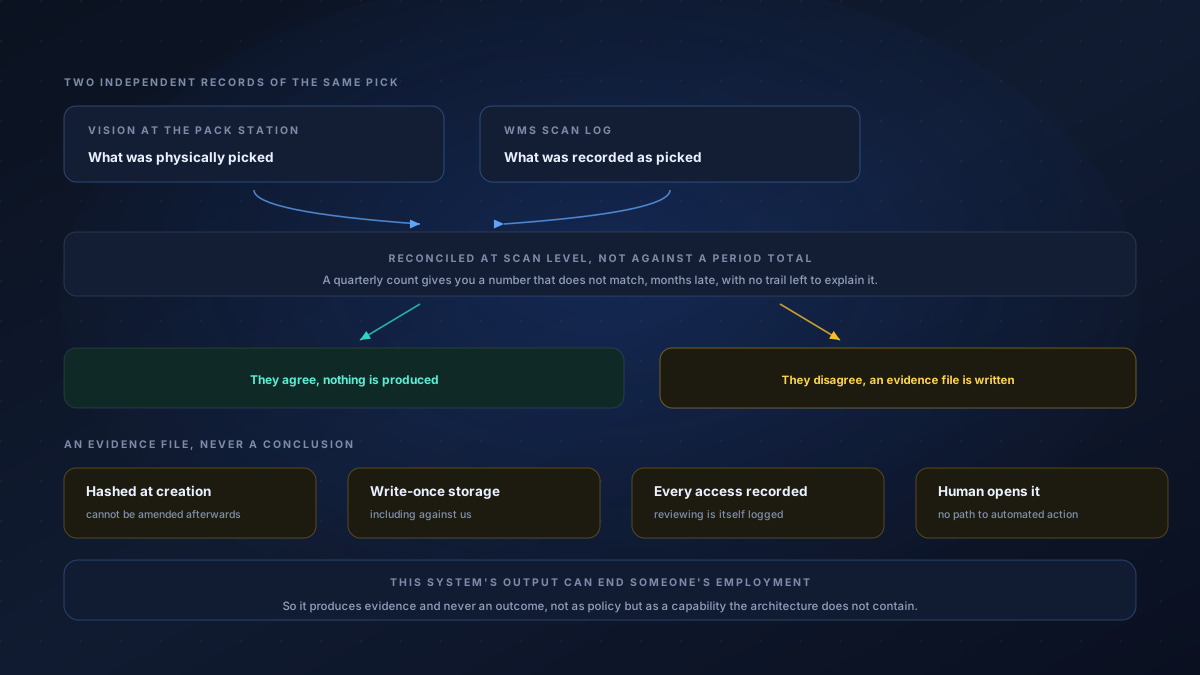
Pick verification reconciled against WMS scan logs, producing a tamper-evident evidence file. Never a conclusion, because this system's output can end someone's employment.
Client
High-Velocity Fulfilment Operator
Industry
Warehouse Operations · Loss Prevention
Duration
6 months
Year
2025
Background
Shrinkage is normally discovered at a periodic count: a number that does not match, months after whatever caused it, with no record left that could explain when or where. By the time anyone investigates, the footage has rotated, the shift pattern has changed and the trail is cold. The loss is quantified and nothing is learned.
The Challenge
Reconciling what was physically picked against what the warehouse system recorded is straightforward in principle. What made it hard is the consequence: a discrepancy attributed to a station and a time is, in practice, attributed to a person. A false positive here is not a noisy dashboard. It is an accusation, with employment and reputation attached. The system had to be built so that it cannot, by construction, produce an outcome on its own.
Our Solution
SageWare built the verification and reconciliation layer. Vision at pack stations verifies what was actually picked and reconciles it against the WMS scan log for the same event. Where they disagree, the system writes an evidence file (the detection, the scan record, the timestamp and a cryptographic hash) to write-once storage, so it cannot be quietly amended afterwards by anyone, including us. Nothing is raised as a conclusion and nothing triggers an action. A reviewer opens the file, and every access to it is itself recorded.
Key Deliverables
- Vision-verified picks reconciled against the WMS record for the same event
- Hashed, timestamped evidence files on write-once storage, unamendable after creation
- No path from detection to action: human review is structural, not procedural
- Per-platform adapters for SAP EWM and Manhattan rather than a leaky abstraction
Results & Impact
How We Did It
01
Evidence Standard First
Defined what a defensible evidence file had to contain and how it would be protected, before building anything that could generate one.
02
Pick Verification
Deployed vision at pack stations to establish what was physically picked, independently of what was keyed.
03
WMS Reconciliation
Built per-platform adapters to compare each detection against the warehouse system's own record of the same event.
04
Custody & Review
Wrote discrepancies to write-once storage with hashing and access logging, and built the review path that a human must pass through.
Decisions & Trade-offs
This system's output can end someone's employment
That fact drove everything else. The system produces evidence, never a conclusion, and has no path to triggering an action on a person, not as a policy we would follow but as a capability the architecture does not contain. A discrepancy is a file a reviewer opens. Building it the other way would have been simpler and would have demonstrated better in a sales meeting, and the first wrongly-accused employee would have been our design decision rather than someone’s mistake.
Write-once, including against us
Evidence that can be edited after the fact is not evidence, and the party most able to edit it quietly is whoever operates the platform. Discrepancy files are hashed at creation and written to storage that cannot be amended, with every subsequent access recorded. It means we cannot correct a malformed record. We can only supersede it, leaving the original in place. That is inconvenient exactly as often as it is the point.
An adapter per warehouse system, not an abstraction over them
SAP EWM and Manhattan model a pick differently enough that a shared abstraction leaks on the details that matter for reconciliation. We wrote an adapter per platform against a thin internal contract. It costs a new adapter for every warehouse system encountered, and it means one vendor changing its data model breaks one adapter rather than the reconciliation logic underneath all of them.
Scope & Boundaries
We built the verification, reconciliation and evidence layer. The WMS remained the system of record for inventory. Investigation, HR process and any consequence were entirely the client’s. We were explicit in writing that the system informs a human decision and does not make one, and we would not have built it otherwise.
Next Case Study
VitalSense: Patient Deterioration Monitoring
Clinical Operations · Patient Safety