
VitalSense: Patient Deterioration Monitoring
Rolling early-warning scores from vitals and notes, with pose estimation for falls. Every alert carrying the reason, because a ward silences anything that does not.
Client
Hospital Group, Acute Inpatient Units
Industry
Clinical Operations · Patient Safety
Duration
8 months
Year
2025
Background
Deterioration on a ward is usually visible in the record before it is visible to a person. Observations are taken, notes are written, and the trend that matters is spread across them at intervals nobody has the capacity to correlate continuously. The consequence of noticing late is measured in outcomes, and the ratio of staff to patients makes continuous observation arithmetically impossible.
The Challenge
Wards already suffer alarm fatigue, and the failure mode of a clinical scoring system is not being wrong. It is being ignored. Any alert competing with existing alarms has seconds to justify itself to someone mid-task. The second constraint was physical monitoring: detecting falls and agitation needs vision, and putting cameras in patient rooms is only acceptable if the images cannot become a record of anyone.
Our Solution
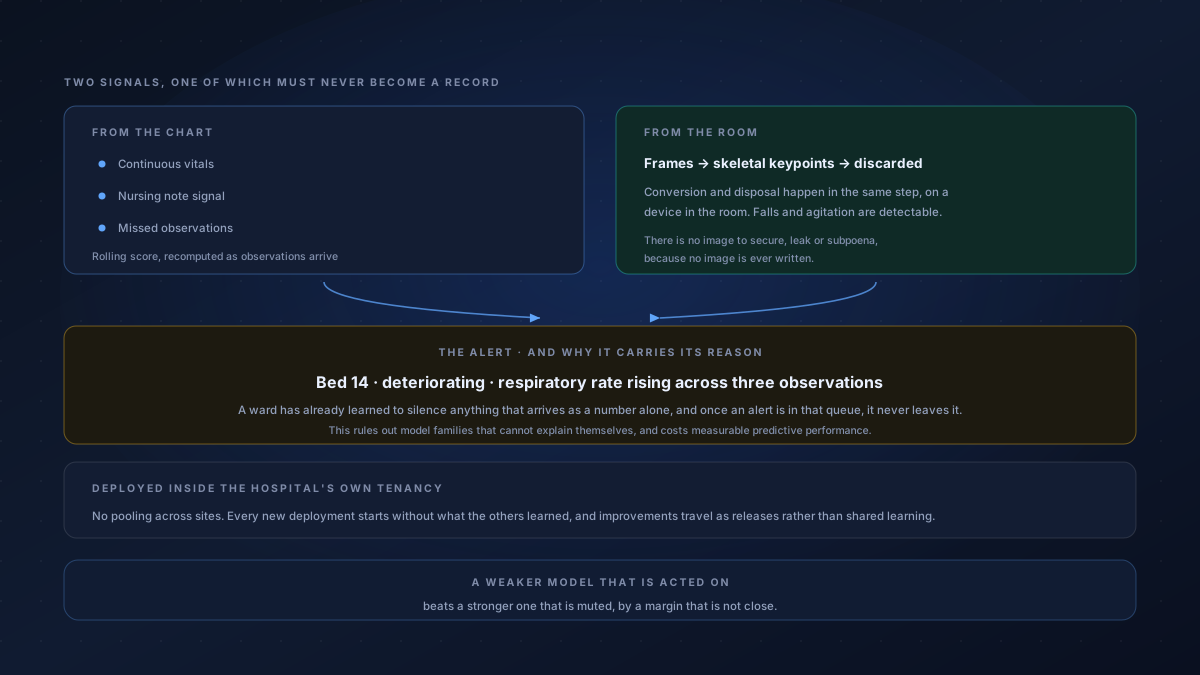
SageWare built the ingestion, scoring and alerting layers. Vitals stream in continuously and a time-series model produces a rolling score alongside signal from nursing notes. Vision is handled at the edge: frames are reduced to skeletal keypoints in the room and discarded immediately, so falls and agitation are detectable while no image is ever stored or transmitted. Alerts reach nurse dashboards carrying what moved (the trend, the note, the missed observation) rather than a score alone. The whole deployment runs inside the hospital's own tenancy.
Key Deliverables
- Rolling early-warning scores from continuous vitals combined with nursing note signal
- Video reduced to skeletal keypoints at the edge, with frames discarded and never stored
- Alerts carrying the contributing signal rather than a score alone
- Deployed inside the hospital's own tenancy, with clinical data never crossing the boundary
Results & Impact
How We Did It
01
Alert Economics
Established what an alert had to contain to survive contact with a working ward, before choosing a model, because that requirement constrains the model.
02
Vitals & Notes Pipeline
Built continuous ingestion of observations alongside signal extracted from nursing notes into a single rolling view per patient.
03
Edge Pose Estimation
Reduced video to skeletal keypoints in the room with frames discarded immediately, making fall detection possible without images existing.
04
In-Tenancy Deployment
Deployed inside the hospital's own environment with customer-managed keys, so clinical data never crosses their network boundary.
Decisions & Trade-offs
An alert without a reason becomes noise within a week
A score alone joins the queue of things a ward has already learned to silence, and once it is in that queue it never comes out. Every alert carries what moved. The respiratory trend, the phrase in the note, the observation that was not taken. This rules out model families that cannot explain themselves and costs measurable predictive performance. A slightly weaker model that is acted on outperforms a stronger one that is muted, by a margin that is not close.
Pose estimation, and the frames never exist
Fall and agitation detection needs vision. Storing or transmitting video of patients is a different system with a different acceptability threshold, and clinical staff would have been right to resist it. Frames are converted to skeletal keypoints on a device in the room and discarded in the same step, so there is no image to secure, leak or subpoena. It costs edge hardware per unit and makes model updates a fleet operation rather than a deploy.
No pooling across hospitals
A model learning across every deployment would be better, particularly for rarer presentations, and we did not build it that way. Each hospital runs isolated, inside its own tenancy, with nothing crossing the boundary. The cost is real: every new site starts without the benefit of what the others learned, and improvements propagate as model releases rather than as shared learning. That was the only version the clinical governance conversation could reach a yes on.
Scope & Boundaries
We built the ingestion, scoring, edge vision and alerting layers, deployed inside the client’s environment. Clinical escalation protocol was theirs. The system raises and explains, and does not recommend treatment. Device procurement and ward installation were joint; model releases are ours to produce and theirs to accept.
Next Case Study
TradeWatch: Trade and Communications Surveillance
Capital Markets · Surveillance