
ERP & Financials
500K+Transactions per day
The Financial Core
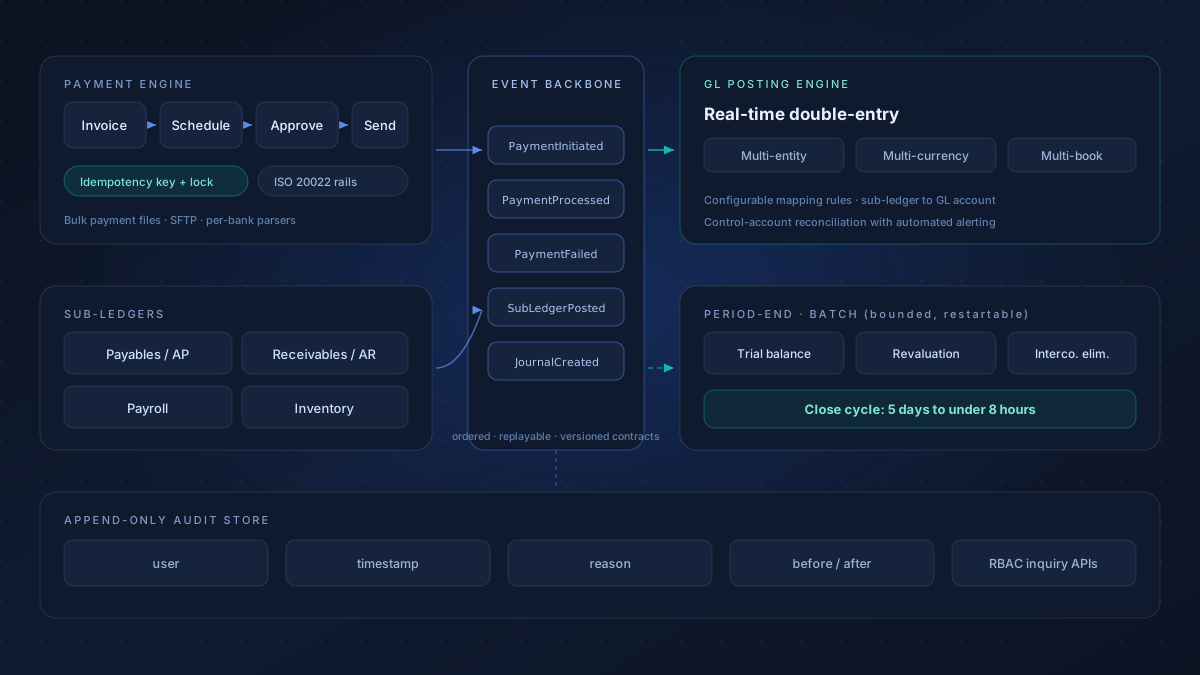
Payments and the general ledger rebuilt as one event-driven backbone. 500K+ transactions a day, and a period-end close that fell from five days to under eight hours.
Read the case studyWe build the systems that power your business.
Scaling and security are in our DNA.
Sectors we have delivered in
Most of our engagements are anonymised. Each sector links to the work itself.
We build the systems a business runs on. Securing them and sizing them for the load is part of that build, not a phase after it.
Build
Whatever the operation stops without is the system we build. And whatever it needs on top of that: detection, reconciliation, decisioning.
Secure
Nothing reaches it without proving who it is. Nothing inside it holds more access than it needs. Anything uninvited is blocked, logged and reported.
Scale
Cloud, on-premises or hybrid. Your call, not our constraint. Built for the volume the operation actually carries: one financial core we built clears 500K transactions a day.
Four business domains (ERP, financials, workforce and supply chain) and the four engineering disciplines that build and keep them running.
Sage X3 and Sage 300 rollouts, version upgrades and validated data migration, proven before go-live.
Learn moreGeneral ledger engines, payment automation and ERP integrations built event-driven for throughput and audit.
Learn moreHRMS platforms where attendance, payroll, performance and self-service run as one auditable system.
Learn moreWarehouse execution, barcode-driven stock movement, carrier integration and demand forecasting.
Learn morePrediction, real-time scoring and vision at the edge, built so the alert is acted on rather than muted.
Learn moreThe portals, consoles and dashboards people actually work in, built to stay fast at real data volumes.
Learn moreOffline-first field and operations apps that keep working when the network does not.
Learn morePhased migration, containerisation and infrastructure as code for systems that cannot afford to stop.
Learn moreScanning, secrets management and policy as code in the pipeline, not a report after you have shipped.
Learn moreThree engagements from three domains. Every figure comes from the delivered system.
Not every engagement is a whole programme. Most of ours are one defined stream inside someone else's.
We own the outcome end to end.
Process mapping through configuration or build, testing, cutover and training. You get one accountable team and a single delivery plan.
Best when: a new rollout, or a system being replaced.
We own one stream inside your programme.
The QA and functional stream on a rollout someone else leads, or the engineering stream on a specific module. Scope boundaries are agreed in writing at the start.
Best when: a programme is already running and one part needs depth.
Our consultants work inside your team.
Functional consultants or engineers embedded alongside your people, under your delivery process, for a defined period. Knowledge stays with you.
Best when: you have the plan but not the specialists.
A short, fixed piece of work.
An upgrade readiness assessment, a data migration risk review, a process and gap analysis, or a second opinion on an architecture before you commit to it.
Best when: you need a decision made well before spending the budget.
Map the process, design the system, build it, prove it before go-live, then hand it over properly.
Before any configuration or code, we map how the business actually works against the standard flows: Procure-to-Pay, Order-to-Cash, Record-to-Report and manufacturing. Most system failures are process failures wearing a technical costume, and this is where they surface.
Module configuration where a packaged platform fits, engineering where it does not. Service boundaries, data contracts and integration points are fixed in writing first, along with the trade-offs we are accepting and why.
Delivery in short cycles against the mapped processes, with the business seeing working software rather than status reports. Where we are engineering, correctness on the paths that move money comes before anything else.
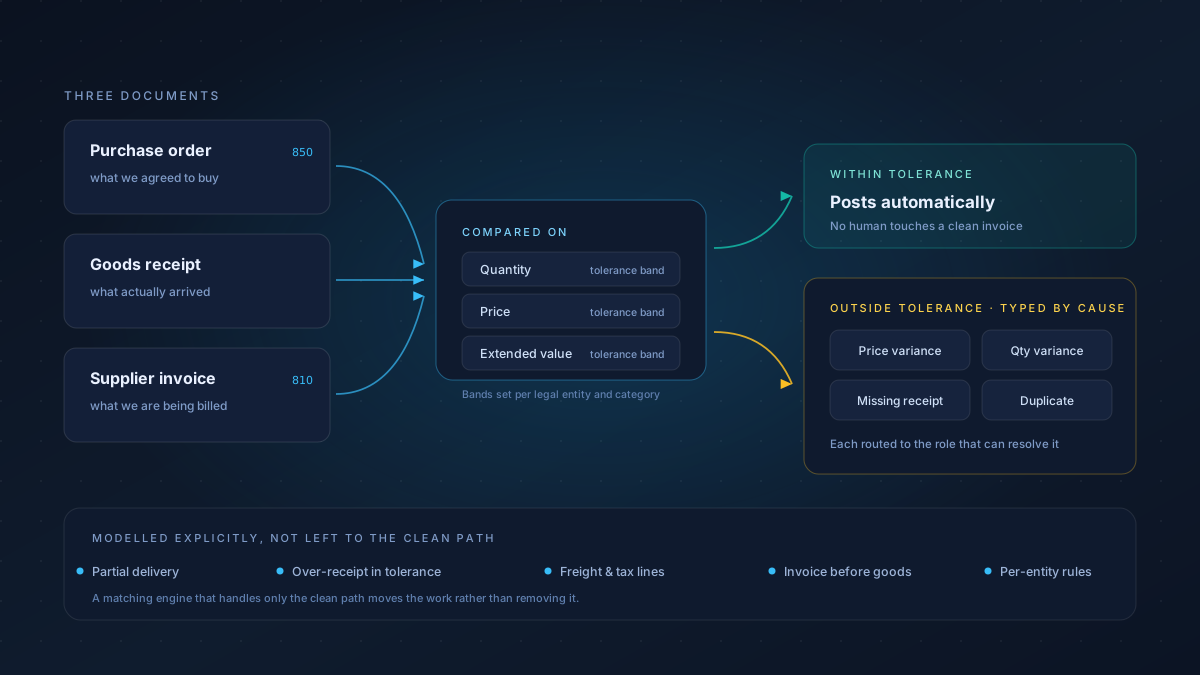
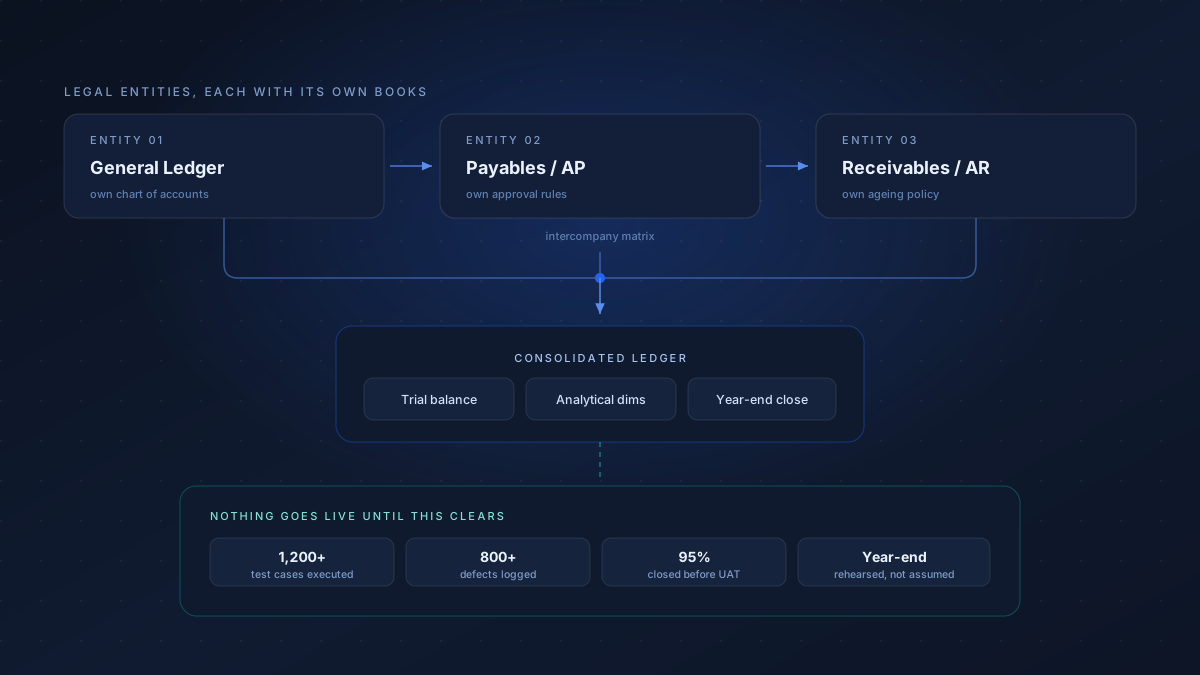
Functional, regression and integration testing against the documented processes, with every defect tracked to verified closure before UAT opens. Migrated data is reconciled against source and every variance traced to a cause. A matching row count is not a reconciliation.
Adoption is part of delivery, not an upsell. A system nobody trusts is a spreadsheet with extra steps. We train the people who operate the system, not only those who administer it, then hand over runbooks and evidence rather than just credentials.
Sage X3 and Sage 300 for implementation, version upgrade, migration and functional support. We also build and extend modules inside custom and in-house ERP platforms: general ledger, payables and receivables, payment automation, warehouse and shipping, and EDI document exchange.
Both, and most of our work is the second. Typical engagements are adding a financial or workforce module to an ERP that is already live, replacing an overnight batch integration with an event-driven one, upgrading across versions, or migrating between environments, all without interrupting the business running on top of it.
Every migration is rehearsed in non-production before it touches production. We reconcile migrated master and transactional data against source, trace every variance to root cause rather than accepting a matching row count, and cut over against a runbook with a tested rollback. Reconciliation evidence is part of the deliverable.
Functional, regression, integration and API testing executed against documented business processes: procure-to-pay, order-to-cash, record-to-report and manufacturing flows. Defects are logged and tracked to verified closure before UAT opens. You receive the test library and the defect trail, not just a sign-off email.
A 30-minute call with the engineers who would do the work. You will get a straight answer on scope, sequence, and what we would not take on.