

Multi-Entity ERP Finance & Distribution Rollout
A multi-company Sage X3 finance and distribution rollout validated with 1,200+ test cases — and 35% fewer defects after go-live.
Client
Multi-Entity Manufacturing & Distribution Group
Industry
Manufacturing · Finance & Distribution
Duration
8 months
Year
2025
Background
A manufacturing and distribution group operating several legal entities was running finance and distribution on fragmented systems. Month-end consolidation was manual, intercompany balances were reconciled in spreadsheets, and every fiscal year-end close consumed weeks of the finance team’s capacity. Leadership committed to a single Sage X3 platform across all entities — and needed the rollout validated before it touched live financial data.
The Challenge
Finance rollouts fail quietly. A misconfigured analytical dimension or an unmapped intercompany account does not crash the system — it produces a trial balance that looks plausible and is wrong. The group needed every finance and distribution process proven across multiple company codes before go-live, with a defect trail rigorous enough to satisfy auditors, and without a single unreconciled account reaching production.
Our Solution
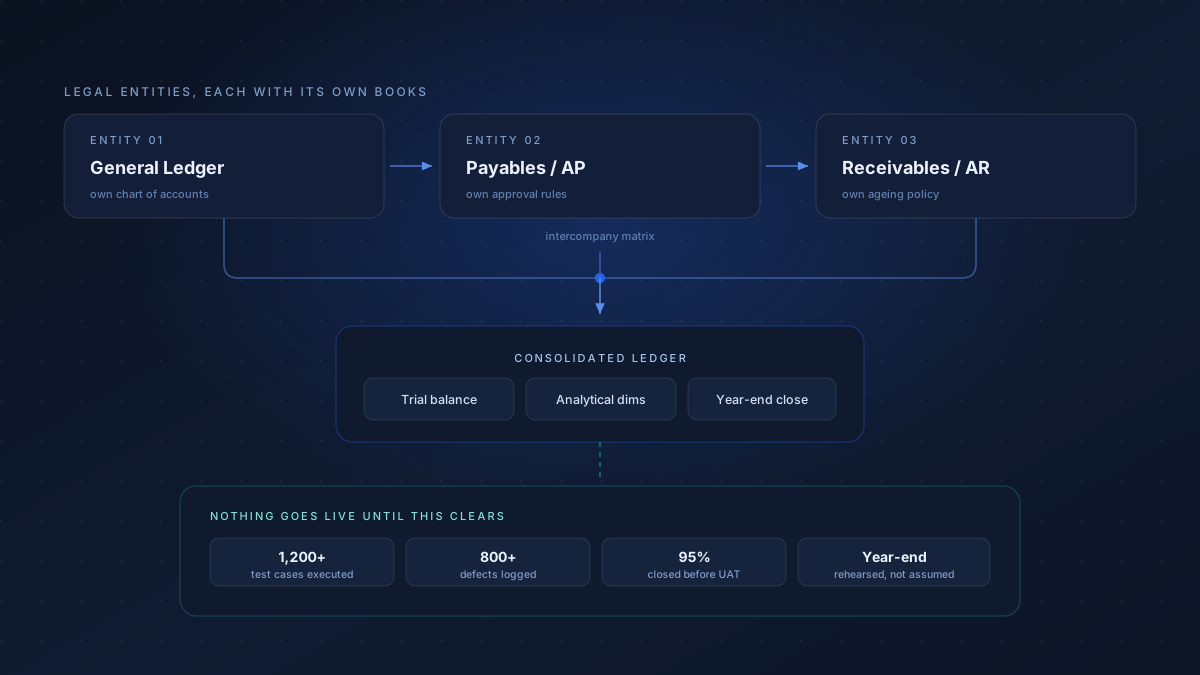
SageWare ran the functional and quality workstream end to end. We mapped every in-scope process against Procure-to-Pay, Order-to-Cash and Record-to-Report, then built a test library covering general ledger, AP, AR, analytical accounting, intercompany matrix configuration, supplier expense processing, and fiscal year-end close. Each cycle was executed across entities, defects were logged and tracked to closure in Jira, and trial balance discrepancies and data conversion variances were traced to root cause in SQL before sign-off.
Key Deliverables
- 1,200+ functional and regression test cases across finance, supply chain and manufacturing
- Intercompany matrix and analytical accounting configuration validated per legal entity
- Trial balance discrepancies and data conversion variances traced to root cause in SQL
- Full fiscal year-end close rehearsed and proven before production cutover
Results & Impact
How We Did It
01
Process Mapping & Gap Analysis
Mapped existing finance and distribution processes against P2P, O2C and R2R, documenting every gap between current operations and standard Sage X3 behaviour.
02
Test Strategy & Library Build
Authored the test strategy and built a reusable case library covering GL, AP, AR, analytical accounting and intercompany flows across all company codes.
03
Execution & Defect Management
Ran functional, regression and integration cycles per entity. Logged, triaged and tracked defects in Jira, driving each to verified closure before UAT opened.
04
UAT & Year-End Validation
Facilitated business UAT, validated a full fiscal year-end close in a controlled environment, and confirmed trial balance integrity ahead of sign-off.
Decisions & Trade-offs
Entity by entity, not all at once
A single simultaneous go-live across every legal entity concentrates all the risk on one date and gives you nothing to learn from. We sequenced the rollout so the first entity carried the configuration decisions the rest would inherit, and the defects it surfaced were fixed once rather than three times. The cost is a longer calendar; the benefit is that entity three goes live on a configuration that has already survived two closes.
Rehearse the year-end close before go-live, not after
Fiscal year-end is the process that most reliably exposes a misconfigured ledger, and it is also the one nobody tests, because it happens once a year and go-live rarely lands near it. We ran a full year-end close in a controlled environment against migrated balances. It is slow, it is unglamorous, and it is where the analytical accounting gaps surfaced — months before they would have surfaced on their own.
Trace every variance rather than accept a tolerance
It is tempting to set a materiality threshold and wave through anything below it. In a rollout that means shipping unexplained behaviour into a system that has to be audited. Every trial balance discrepancy and data conversion variance was traced to root cause in SQL before sign-off, including the small ones, because a small variance with an unknown cause is not small — it is unknown.
Scope & Boundaries
We ran the functional and quality workstream. Infrastructure, licensing and the hosting environment were the client’s, and statutory reporting for each jurisdiction stayed with their local finance teams — we validated that the ledger produced the figures those reports consume, not the reports themselves.
Next Case Study
Barcode-Driven Warehouse & Multi-Carrier Shipping
Logistics · Warehouse & Fulfilment