
The systems nobody wants to touch.
Functional consultants who know how finance, distribution and manufacturing genuinely behave inside an ERP, and engineers who build the systems underneath them. Two disciplines that rarely sit at the same table.
The Sageware Technology Story
Sageware Technology exists for a particular kind of problem: the systems a business actually runs on, the ledger, the payroll, the warehouse, the ERP, are the hardest to change and the most expensive to get wrong.
Plenty of firms will build you a new application. Far fewer will go near the general ledger that has to reconcile, the payroll that has to be right on the 30th, or the upgrade that cannot lose a single record. That is the work we chose.
Our practice grew out of two disciplines that rarely sit at the same table: functional consultants who know how finance, distribution and manufacturing genuinely behave inside an ERP, and engineers who build event-driven systems where a retried payment must never become a second one.
What the practice grew into follows from that. Once you are inside the ledger and the warehouse, the next questions are always the same: what is leaking, what is about to go wrong, and who should be told. So we also build the layer that reads those systems: reconciliation, prediction, real-time scoring, vision on a warehouse floor. And the products and consoles people work in on top of them.
Today we work with organisations across India and beyond, implementing and upgrading ERP platforms, engineering the financial, workforce and supply chain systems inside them, building the detection and decisioning layers above them, and running the cloud and security engineering that keeps the whole thing available.
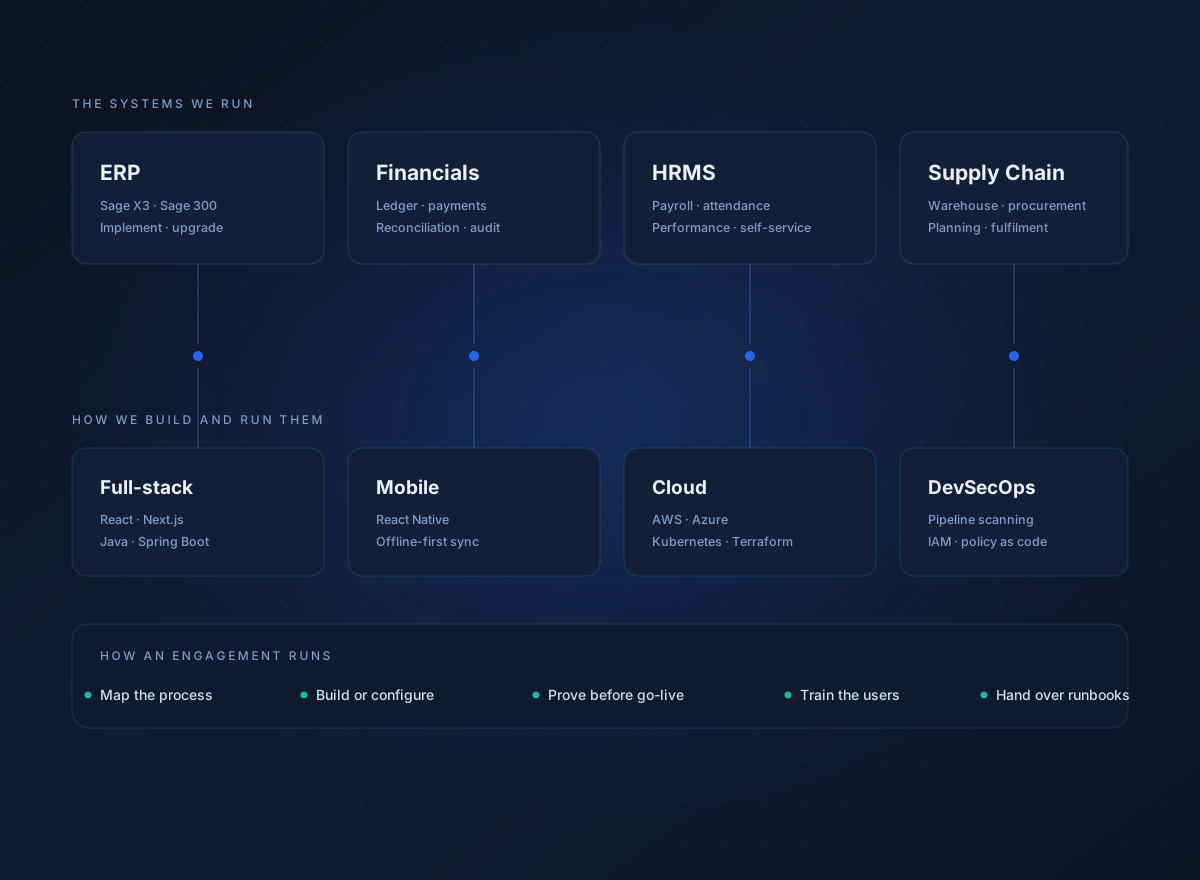
Two disciplines that rarely sit at the same table
Most firms have one or the other. The consultants who understand a trial balance usually do not build the service that posts to it, and the engineers who build it usually have not sat with the finance team that has to close on it.
Functional consulting
Knows how the business actually behaves inside the package.
Process mapping against Procure-to-Pay, Order-to-Cash and Record-to-Report before configuration starts, because most ERP failures are process failures wearing a technical costume. Configuration across Finance, Distribution and Manufacturing, then the testing that proves it before anyone depends on it.
Sage X3 · Sage 300 · UAT and defect closure
Systems engineering
Builds what the package cannot.
Ledgers and payment engines where a retry must never become a second payment, the integration that moves documents between organisations, and the detection and reconciliation layers that sit on top of all of it. Event-driven where throughput demands it, batch where a period-end needs to resume rather than replay.
EDI X12 · ISO 20022 · event-driven posting
Where they meet
ERP & financials
Rollout, upgrade and migration, and the financial modules built inside them.
Supply chain
Warehouse execution, planning, procurement and trading-partner integration.
Workforce
Payroll, attendance and the compliance rules that differ by jurisdiction.
Cloud & product
The surfaces people work in, and the platform engineering underneath them.
What drives us
The core principles behind every decision and every line of code we write.
Correctness over cleverness
On any path where money moves or a record must survive an audit, we take the boring provable option. Novelty is not a virtue in a general ledger.
Prove it before go-live
Every implementation carries a documented test library and defect trail. We would rather find a defect in UAT than explain one in production.
Map the process first
Most system failures are process failures wearing a technical costume. We map how the business actually works before we configure or write anything.
Leave it auditable
Systems we build record who changed what, when and why. Handover means the evidence and the runbooks, not just a set of credentials.
Adoption is part of delivery
We train the people who use the system, not only the people who administer it. A system nobody trusts is a spreadsheet with extra steps.
Say what we did not do
Scope boundaries in writing, at the start. The fastest way to lose a client is a capability they assumed they had bought.
Seven practices, one team
The same engineers move between them, which is the point. An ERP rollout that needs a custom ledger does not become two vendors, and a model that has to read operational data does not wait on a separate integration project.
ERP & quality
Sage X3 and Sage 300 rollouts, upgrades and migrations, proven before they reach production.
3 implementations · 5+ upgrade programmes · 50,000+ tests executed · 5,000+ records reconciled
Financial systems
The ledgers, payment engines and document pipelines at the centre of an enterprise platform.
500K+ transactions a day · period-end close from five days to under eight hours
AI & machine learning
Prediction, real-time scoring and vision, built so the output is acted on rather than muted.
Supply chain
Warehouse execution and trading-partner integration, usually inside an ERP rather than beside it.
Three carrier integrations exercised end to end against live payload contracts
Workforce
HRMS platforms where payroll is right on pay day and the calculation can be shown.
Product & mobile
The surfaces people work in, including the ones off-the-shelf front ends handle badly.
Cloud & platform
Migrating systems that cannot stop, and securing the pipeline that deploys them.
Every figure here comes from work we have delivered, and we will evidence any of it on request. Where a practice carries no figure, it is because nothing on this site evidences one yet. We do not publish client logos we have not been given permission to use.
Tell us what the system has to do.
Thirty minutes with the engineers who would do the work. Scope, sequence, and a straight answer on what we would not take on.