
SentryFloor: Warehouse Safety Monitoring
Computer vision on existing CCTV for PPE and forklift proximity. Running on the floor, because shipping footage of a workforce off-site changes what the system is.
Client
Multi-Site Distribution Operator
Industry
Warehouse Operations · Safety
Duration
5 months
Year
2025
Background
The injuries that get recorded in a warehouse are mostly forklift-pedestrian contact and consequences of missing protective equipment. The control against both is usually a periodic walk-round, which samples a few minutes of a shift. The near-misses that predict the eventual collision, the ones where someone stepped back in time, are almost never observed, so the pattern that would have identified the dangerous intersection is invisible.
The Challenge
The technically obvious design streams camera feeds to the cloud and scores them centrally, and it is the wrong system. Continuously transmitting and retaining footage of a workforce is a different proposition from detecting a safety event, both in what it requires and in how the people on that floor relate to being filmed. The engineering problem was getting useful detection without the footage ever leaving the building.
Our Solution
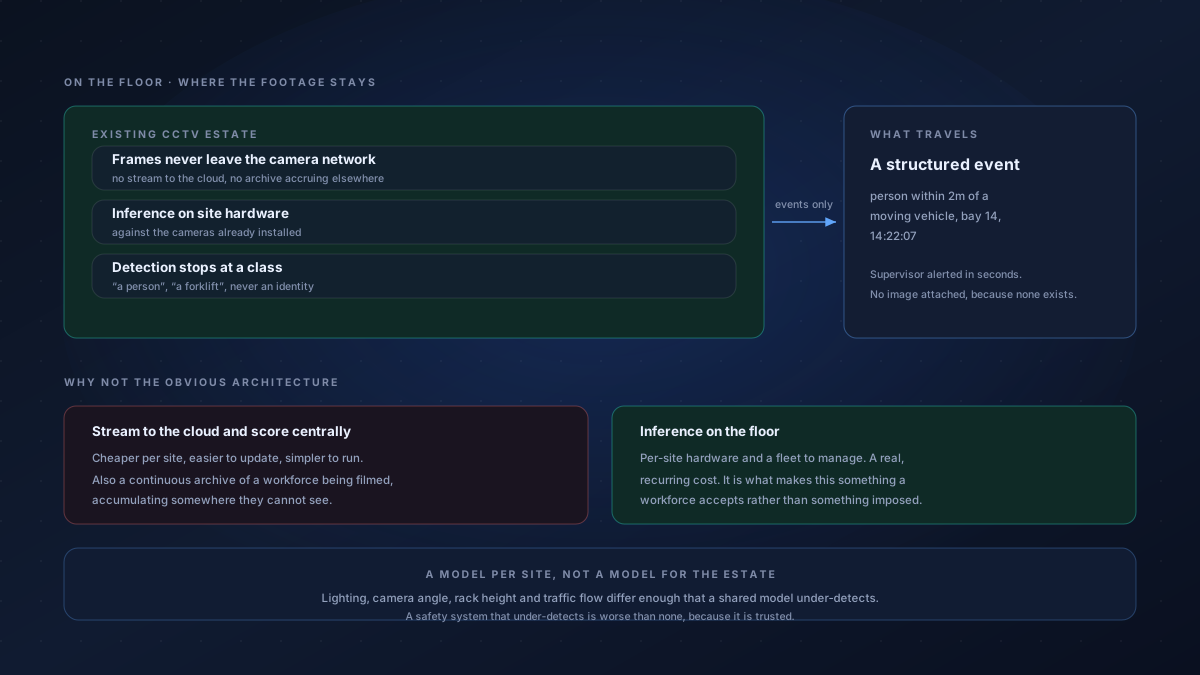
SageWare built the edge pipeline and the fleet layer above it. Inference runs on hardware installed at each site against the cameras already there, and what leaves the building is a structured event. A person within a defined distance of a moving vehicle at a named bay, a missing item of equipment in a zone that requires it. Detection is deliberately anonymous: bounding boxes classify a person or a vehicle and go no further. Alerts reach supervisors within seconds; the central plane handles model rollout and device health, never video.
Key Deliverables
- Inference on site against the existing CCTV estate, with footage never leaving the building
- Anonymous detection by design: classes, not identities
- Structured safety events routed to supervisors within seconds
- Per-site calibration for lighting, angle and layout, with central rollout and device health
Results & Impact
How We Did It
01
Site Survey
Assessed existing camera coverage, lighting and traffic patterns per site, since all three determine what is detectable before any model exists.
02
Edge Deployment
Installed inference hardware against the existing CCTV estate so detection runs locally and footage stays on site.
03
Event Model & Alerting
Defined the structured events worth raising and routed them to supervisors within seconds of detection.
04
Fleet & Calibration
Stood up central model rollout and device health monitoring, with per-site calibration for lighting, angle and layout.
Decisions & Trade-offs
Edge inference is the design, not an optimisation
Central scoring is cheaper per site, easier to update and simpler to operate. It also means a continuous stream of workforce footage leaving the building and accumulating somewhere. We put inference on the floor so only structured events travel, and accepted per-site hardware and a fleet to manage. The cost is real and recurring. It is what makes the system something a workforce will accept rather than something imposed on them.
No faces, deliberately
Identifying individuals would let the system attribute repeated violations to a person, which sounds like a feature to whoever is paying for it. It also converts a safety tool into a surveillance tool and changes the consent surface entirely. Detection stops at “a person”. The trade is that a supervisor sees a dangerous pattern at a location rather than a name, and has to go and look. We think that is the right place for a human to enter.
A model per site, not a model for the estate
One model across every warehouse would make rollout a deploy. In practice lighting, camera angle, rack height and traffic flow differ enough that a model tuned on one site degrades noticeably at the next, and a safety system that under-detects is worse than none because it is trusted. Each site is calibrated. It makes adding a warehouse a piece of work rather than a configuration change, and we priced it that way.
Scope & Boundaries
We built the edge pipeline, the event model, alerting and the fleet layer. Camera hardware and network were the client’s existing estate. What happens after an alert (intervention, coaching, escalation) was their safety process to define; we raise the event and record it, and the system takes no action on a person.
Next Case Study
StockWatch: Inventory Shrinkage Detection
Warehouse Operations · Loss Prevention