
DealSignal: Deal Risk and Pipeline Health Scoring
Deals scored against engagement signals rather than rep optimism, so a slipping deal surfaces weeks before the review it would otherwise be explained in.
Client
Enterprise Sales Organisation, Multi-Region Pipeline
Industry
Revenue Operations · Sales Intelligence
Duration
4 months
Year
2025
Background
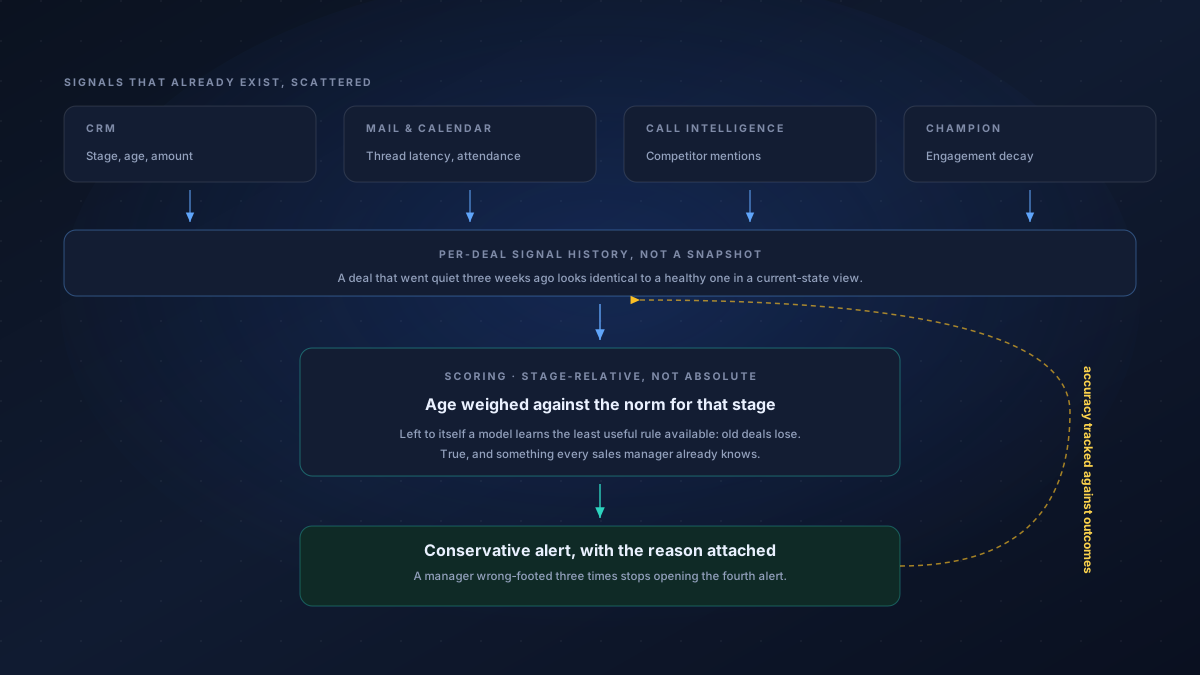
A forecast assembled from what each representative believes about their own deals is a forecast assembled from optimism. The information that would contradict it already exists. A thread that went quiet three weeks ago, a champion who stopped attending, a deal sitting in a stage far longer than deals in that stage usually sit, but it is scattered across the mail server, the calendar and the call recordings, and nobody correlates it until the quarterly review explains what already happened.
The Challenge
Two things make this harder than it looks. The signals are weak and heavily correlated, so a model left to itself learns the least useful rule available: old deals lose. That is true, unactionable, and something every sales manager already knows. The second is that the output is an interruption. An alert that fires on a healthy deal costs a manager's attention, and a manager who has been wrong-footed three times stops opening the fourth alert, at which point the system has negative value, because the alerts that matter are now also ignored.
Our Solution
SageWare built the scoring platform and the product around it. Engagement signals are ingested by webhook from the CRM, the mail and calendar surface, and the call intelligence tool, then normalised into a per-deal signal history rather than a snapshot. The scoring service weighs deal age against the norm for that stage, not against a fixed threshold, so a long enterprise cycle is not permanently penalised for being one. Alerting is deliberately conservative and routed into Slack where managers already work, with the reason for the score attached to the alert so it can be judged rather than trusted. Forecast accuracy is tracked against outcomes over time, which is what allows the scoring to be argued with and corrected.
Key Deliverables
- Engagement signals ingested by webhook from CRM, mail, calendar and call intelligence
- Deal age weighed against stage norms rather than a fixed threshold
- Every alert carries the reasoning behind its score, so it can be judged
- Forecast accuracy tracked against outcomes over time
Results & Impact
How We Did It
01
Signal Inventory
Established which signals genuinely precede a slip and which merely accompany one, before any scoring logic was written.
02
Ingestion & History
Built webhook ingestion from CRM, mail, calendar and call intelligence into a per-deal signal history rather than a current-state snapshot.
03
Scoring Service
Stood up the scoring service with stage-relative norms, and exposed the reasoning behind each score alongside the score itself.
04
Alerting & Accuracy Loop
Routed conservative alerts into Slack with reasons attached, and instrumented forecast accuracy so the scoring could be corrected against outcomes.
Decisions & Trade-offs
Half the obvious signals are only true in hindsight
The features that predict a lost deal best are the ones that exist because it was already lost. Activity decays after a rep gives up, not before; a close date gets pushed once the slip is already known. Train on those and the model scores beautifully in validation and tells you nothing you could have acted on. We restricted the feature set to what is genuinely observable at the moment of scoring. Validation numbers came down. The alerts became worth reading.
Optimise the alert, not the accuracy
Most open deals in most pipelines do not close in the quarter they are forecast for, so a model rewarded for accuracy learns to predict slippage on everything and is right most of the time. We tuned instead for precision at the point where an alert actually fires, accepting that some slipping deals are never flagged. Missing a slip costs one deal. Alerting on a healthy one costs the manager’s trust, and after three of those nobody opens the fourth alert.
A score nobody can argue with is a score nobody acts on
A sales manager who is told a deal is at risk will immediately ask why, and “the model says so” ends the conversation badly. Every score carries the contributing signals that produced it, which rules out model families that cannot explain themselves and costs some predictive power. In exchange the manager can disagree, check, and tell us when we are wrong — which is the only mechanism by which the scoring ever improves.
Scope & Boundaries
We built the ingestion, the scoring service and the alerting surface. The CRM stayed the system of record for deal state and we never wrote back to it. Call recording and transcription remained the client’s existing tooling — we consumed its output and did not touch capture, retention or consent, which sat with their legal team.
Next Case Study
Velocity: Quote-to-Cash Automation
Subscription Revenue · Order-to-Cash