
Velocity: Quote-to-Cash Automation
Quote, approval, signature, provisioning, invoice and collection as one resumable pipeline, so the gap between closing a deal and collecting the cash stops being manual.
Client
Subscription Business, Manual Quote-to-Cash Chain
Industry
Subscription Revenue · Order-to-Cash
Duration
6 months
Year
2025
Background
Between a deal closing and the cash arriving sits a chain of steps that no single system owns: a quote is built, redlines are agreed, approvals are chased, a signature is collected, the account is provisioned in billing, an invoice goes out, and somebody follows up when it is not paid. Every handover is a queue, and every queue is days added to DSO. The work is not difficult. It is that it is done by people, in sequence, and each person only knows their own step.
The Challenge
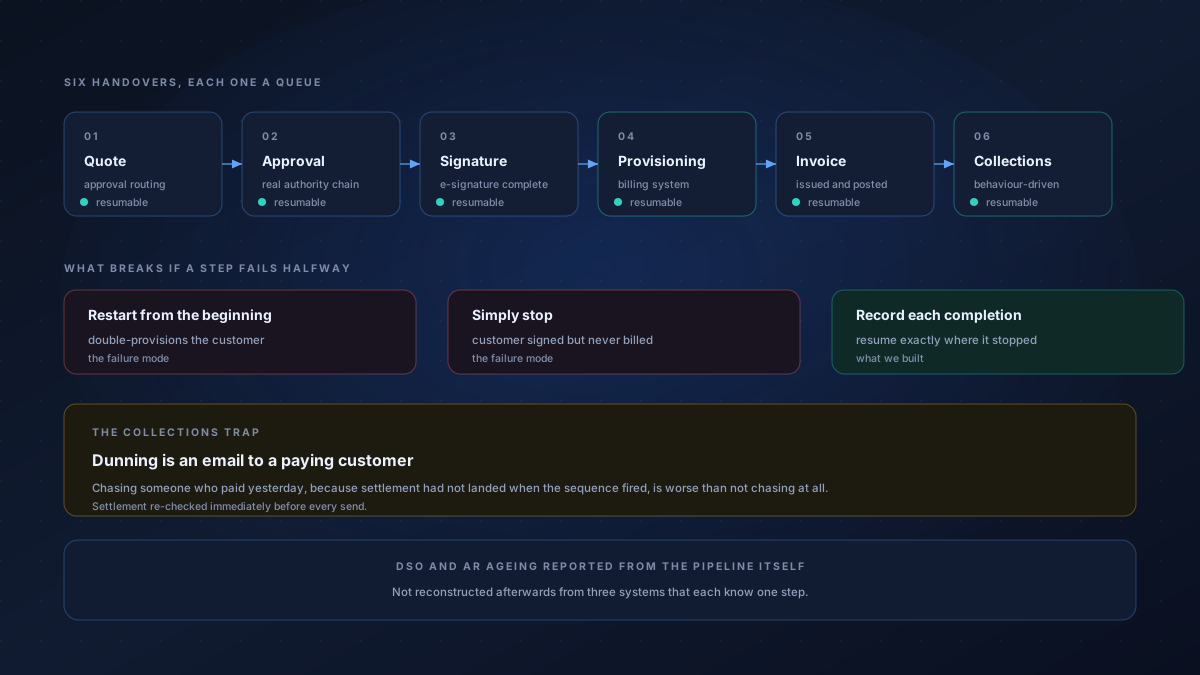
Modelling this as a single automated flow means accepting that any step can fail halfway. A signature completes but provisioning times out; an invoice is issued but the ledger write does not land. A pipeline that restarts from the beginning double-provisions; one that simply stops leaves a customer signed but not billed. The second problem is collections: dunning is an email to a customer, and emailing someone who paid yesterday because the payment had not yet settled when the sequence fired is a worse outcome than not chasing at all.
Our Solution
SageWare built the orchestration as an event-driven pipeline where each step is individually resumable and idempotent. Quote generation carries configurable approval routing, so the chain reflects the organisation's actual authority rather than a hard-coded ladder. E-signature completion triggers provisioning in the billing system, which triggers invoice issuance, each step recording its own completion so a restart resumes rather than repeats. Collections sequences are driven by observed payment behaviour rather than a fixed calendar, and every dunning step re-checks settlement immediately before sending. DSO and AR ageing are reported from the pipeline itself rather than reconstructed afterwards.
Key Deliverables
- Quote, approval, signature, provisioning, invoice and collection as one orchestrated flow
- Every step idempotent and individually resumable after a partial failure
- Approval routing configurable against real organisational authority
- Settlement re-checked immediately before every dunning send
Results & Impact
How We Did It
01
Chain Mapping
Documented every handover between deal closed and cash collected, including the informal ones, and where each one actually waited.
02
Approval Modelling
Made approval routing configurable against the organisation's real authority structure rather than hard-coding a ladder that would be wrong within a quarter.
03
Event-Driven Orchestration
Built each step to record its own completion and to be safely repeatable, so a partial failure resumes rather than double-provisions.
04
Collections & Reporting
Drove dunning from payment behaviour with settlement re-checked before each send, and reported DSO and AR ageing from the pipeline itself.
Decisions & Trade-offs
One orchestrator, not a chain of events reacting to each other
Choreography is tempting here: each service listens for the previous step and acts. It also means that when a customer is signed but not provisioned, the reason is distributed across six services and nobody owns the answer. We put the sequence in a single orchestrator that records state before and after every external call, so partial failure is reasoned about in one place. The cost is a component that must itself stay available, and we treated it accordingly.
On a timeout, ask before you undo
A provisioning call that times out has not failed — it has stopped answering. Compensating immediately is how you de-provision a customer who was successfully provisioned half a second earlier. Every step that can time out has a verification path that queries the downstream system for the real outcome before any compensation runs. It makes the failure path slower and it is the reason no customer has been rolled back out of something they were correctly signed into.
Stuck compensations go to a person, not a retry loop
Compensations are best-effort by nature: undoing an issued invoice or a completed provision can legitimately fail, and retrying forever just hides it. A compensation that does not succeed within its budget is quarantined with the saga state attached and raised to an operator. It means the pipeline sometimes needs a human, which is unsatisfying in a system sold as automation — and considerably better than an account silently wedged between two states.
Scope & Boundaries
We built the orchestration, the approval model and the collections logic. The billing system, the e-signature provider and the general ledger were existing client systems that we integrated with rather than replaced. Credit policy, approval authority and dunning tone were the client’s decisions — we made them configurable and did not set them.
Next Case Study
RenewalRadar: Churn and Expansion Prediction
Revenue Operations · Customer Success