

AmbuRakshak — Ambulance Fleet Operations
A dispatch platform for fleet owners and patients — native background location, over-the-air releases, and booking that now runs entirely through WhatsApp.
Client
Ambuvians
Industry
Emergency Mobility · Fleet Operations
Duration
Ongoing engagement
Year
2025
Background
Ambuvians operates an ambulance network built from independent fleet owners rather than a single owned fleet. That makes it a logistics problem before it is a healthcare one: vehicles and drivers have to be onboarded and verified, availability has to be known in real time, and a booking has to reach the right vehicle quickly. We have built and continue to build the platform that runs it — the operations panel fleet owners work in, the mobile application patients and drivers use, and most recently the WhatsApp channel that booking now flows through.
The Challenge
Three problems shaped the engineering. A dispatch platform is worthless if it loses a vehicle’s position the moment the driver switches apps, and continuous background location is precisely where mobile operating systems push back hardest. A safety-critical application cannot wait days for an app store review when a defect needs correcting. And in an emergency, nobody downloads an app — the people who most need the service are least likely to have installed it in advance.
Our Solution
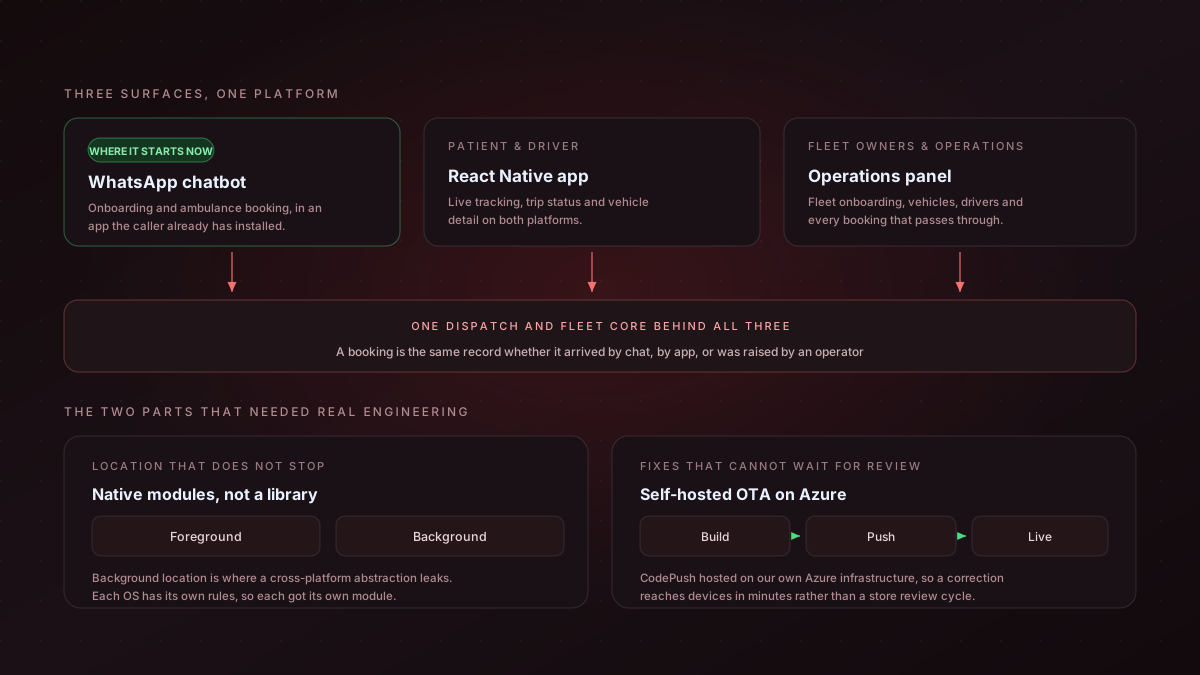
The operations panel at onboarding.ambuvians.in is where fleet owners register and manage vehicles and drivers, and where the operations team sees every booking in the network. The mobile application is React Native with custom native modules on each platform for continuous location capture in both foreground and background, written against each operating system’s own rules rather than through a cross-platform abstraction. Releases go out through CodePush self-hosted on our own Azure infrastructure, so a correction reaches devices over the air in minutes instead of a store review cycle. Most recently we built the WhatsApp chatbot that now carries onboarding and ambulance booking, designed so the same conversational flow can be extended to further channels.
Key Deliverables
- Operations panel for fleet owners covering vehicles, drivers and every booking in the network
- Custom native location modules per platform for continuous foreground and background capture
- Self-hosted CodePush on Azure delivering fixes over the air, without a store review cycle
- WhatsApp chatbot carrying onboarding and booking, built to extend to further channels
Results & Impact
How We Did It
01
Fleet Operations First
Built the operations panel so fleet owners could onboard vehicles and drivers and the operations team could see the network, before any consumer-facing surface existed.
02
Mobile Application
React Native across both platforms, with native location modules written per operating system for continuous foreground and background capture.
03
Release Infrastructure
Stood up self-hosted CodePush on Azure so corrections and improvements reach devices over the air rather than through a store release.
04
Conversational Booking
Moved onboarding and ambulance booking into a WhatsApp chatbot, built so the same flow can extend to further channels without rewriting the logic.
Decisions & Trade-offs
Native location modules rather than a cross-platform package
Foreground location is easy and every library handles it. Background location is where the abstractions leak — doze modes, background execution limits, permission models and the behaviour when the user swipes the app away all differ by platform and change between OS versions. We wrote the module separately for each platform so the behaviour is explicit rather than inherited. It costs us two implementations to maintain; it buys a vehicle position that does not quietly stop reporting.
Self-hosted over-the-air delivery instead of the managed service
Running CodePush on our own Azure infrastructure means we own the rollout mechanism, the release history and where that data sits, rather than depending on a hosted service’s roadmap. The trade is real — it is infrastructure we now operate. For an application people use during an emergency, being able to ship a fix in minutes rather than waiting on an app store review was worth running it ourselves.
Meet people on WhatsApp rather than ask them to install something
The assumption behind a booking app is that the user installed it before they needed it. In an emergency that assumption usually fails. Moving onboarding and booking into WhatsApp removes the install entirely and puts the service in a channel already open on the phone. We built the flow so the conversation logic is not tied to WhatsApp specifically, because the same reasoning will apply to whichever channel comes next.
Scope & Boundaries
We build and run the platform: the operations panel, the mobile application and the WhatsApp channel. The ambulance fleet itself, driver recruitment and medical protocol are Ambuvians’ own — we provide the systems those operations run on, not the operations.
“Sageware understood the stakes immediately. They built something that actually works in real emergencies — not just in a demo environment. That discipline is rare.”
Next Case Study
Phased Cloud Migration Without Downtime
Enterprise Technology & Operations